
9 Best AI Grant Writing Tools That are Actually Useful
Discover the best AI tools for grant writing. Compare tools that help nonprofits, researchers, and teams draft proposals, analyze research, and improve writing.
Grant writing is a notoriously exhausting and time-consuming process. It has long been a slog for research, nonprofits, and growing startups. Writers spend weeks, sometimes months, on a single grant proposal. Typically, the process involves research, drafting, gathering supporting evidence, and aligning the project with strict funding requirements.
Fortunately, specialized AI grant writing tools have made life a little easier for grant writers. Modern AI platforms assist with drafting proposal sections and summarizing lengthy research material. Also, it improves clarity of the final draft and organizes information to meet those picky grant guidelines.
This guide covers nine AI tools for grant writing worth using in 2026.
How We Selected These AI Grant Writing Tools
We evaluated dozens of platforms using the following criteria to identify the best tools for AI-driven grant writing:
- Grant-specific features like proposal drafting, RFP analysis, and understanding of grant requirements
- Data privacy and security (critical for sensitive research and nonprofit data)
- Accurate, professional, and funder-aligned output quality
- Clean interface with minimal learning curve
- Workflow coverage (research, drafting, editing, and organizing)
- Free tiers and reasonable pricing plans for nonprofits and small teams
Okara AI
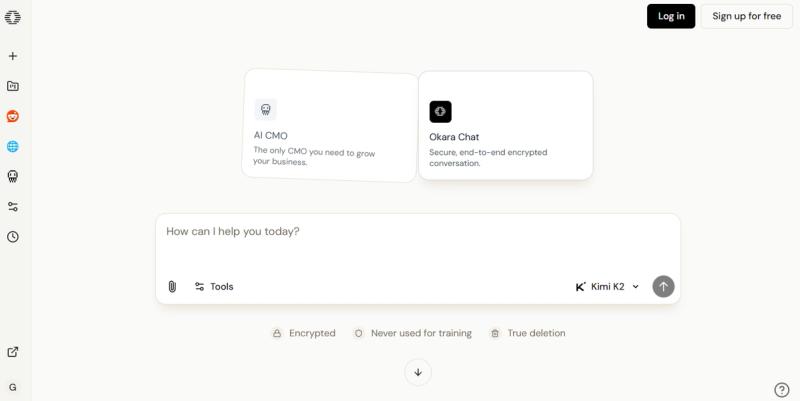
Okara AI is a privacy-first platform that gives access to 20+ open-source models in a single workspace. Professionals working with complex documents and research can benefit from frontier models like Qwen, Llama, Deepseek, and more.
AI capabilities: Grant writers can upload and chat with source documents, including funder guidelines, past proposals, and research papers. Then, you can use AI to extract key stats and draft proposal sections. In addition, Okara has all the tools for grant workflows. You can draft, research, refine, and organize data without leaving the encrypted platform.
Writing and research tasks supported
- Analyze RFPs and funding guidelines to pull important info
- Solid privacy, especially for NIH or research grants
- Summarize supporting literature and review
- Draft sections, including goals, project descriptions, and citations
- Shared memory across conversations
- Multiple specialized tools for research, reasoning, and creative writing
Key strengths for grant writing workflows:
Okara allows you to upload PDFs of past grants and RFPs and ask targeted questions. It summarizes long PDFs and videos into helpful notes and creates drafts that match funder language. Teams appreciate that the unified memory remembers context and organization’s details. This way, you don't have to start from scratch and build on your teammates’ work.
Not to mention, it combines several separate tools that grant writers generally use. For example, a research summarizer, an AI chatbot, document analysis, and more.
Pricing: Okara has a free tier with 50 messages to test its capabilities. Paid plans start at $20/mo (Pro) and $99/mo (Max). A one-time “Founding User” option offers lifetime access at $1000.
Limitations: Okara is a general-purpose AI workspace rather than a grant-specific tool. Therefore, the platform does not have a built-in funder database or deadline tracking.
GrantBoost
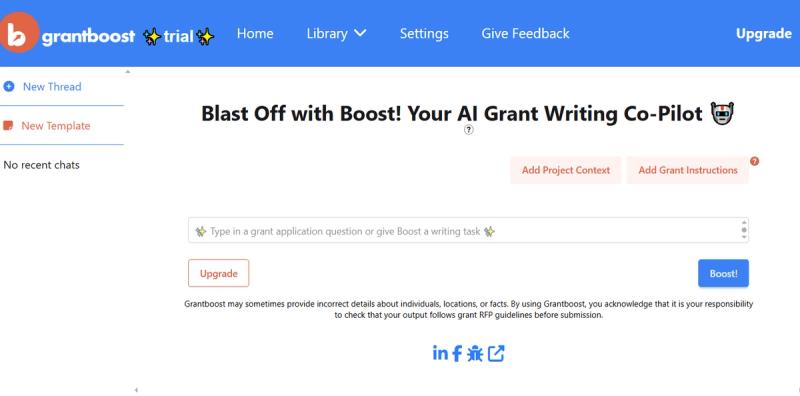
GrantBoost is a purpose-built AI grant writing tool designed for non-profits and small teams. It guides users to write proposals step by step using prompts and AI drafts that follow common grant formats.
AI Capabilities: GrantBoost learns the organization’s mission and programs to write grant proposals accordingly. Furthermore, it analyzes grant opportunities and drafts responses section-by-section. After joining, users answer a quick survey about the team, mission, and funding goals. Then, the AI uses this information to draft proposals.
Writing and research tasks supported
- Drafting full proposal sections based on the organization profile and grant requirements
- Customizing proposal language for each funder's priorities
- Tracking active grant applications
- Store organization details that the AI can use when needed
Key strengths for grant writing workflows:
As mentioned earlier, it is designed for a nonprofit grant writing context. It requires less prompt engineering because GrantBoost is trained on non-profit proposals and compliance. It's “personalized” memory feature quickly learns from your style and gets better the more you use it. You can edit the output to better suit your voice and funding goals.
Pricing: It has a free tier with basic AI grant writing features and templates. Starter and Pro plans are priced at $24.99/mo and $44.99/mo, respectively. Team tier starts at $59.99/mo and a custom plan is available for enterprise.
Limitations: The templates may be too generic for highly technical grants, e.g., NIH research proposals. Plus, it has fewer built-in research tools than all-in-one platforms like Okara.
Grantable
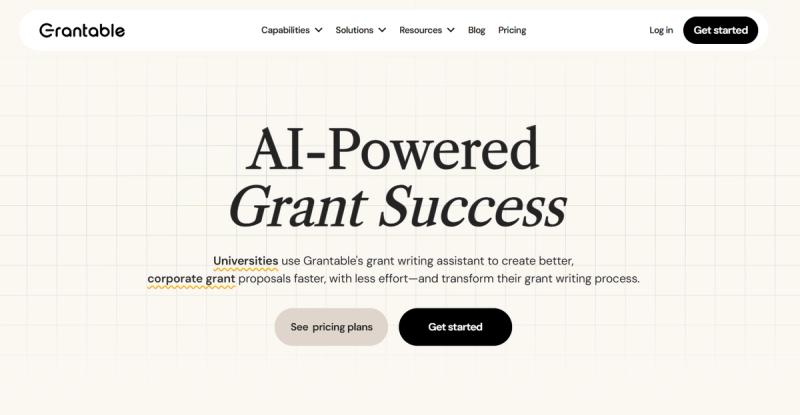
Grantable improves grant writing by learning from samples, previous proposals, and RFPs. The platform helps nonprofit teams in drafting proposals that match your authentic voice. It is SOC 2 TYPE II compliant and does not share your grant content with third parties.
AI capabilities: Grantable uses premium models from OpenAI and Anthropic for writing proposal sections. Additionally, it crafts applications based on the organization’s profile and the requirements of a specific grant opportunity. Compared to general AI, Grantable produces more contextually aware outputs about mission, impact, and program design.
Writing and research tasks supported
- Write compelling grant applications 3x quicker
- Smart library to search all grant content
- Rephrasing content to match funder tone guidelines
- Organizing past proposals for easy reuse
- Track your grant application statuses and deadlines
Key strengths for grant writing workflows: Grantable has two specialized AI interfaces to choose from quick edits and deeper strategy sessions. In addition, it organizes grant content using folders and tags. Users can locate past proposals or RFPs with target keywords. More importantly, the platform has several team collaboration features, like built-in review and feedback tools.
Pricing: Grantable has three paid tiers: Starter ($24/user/mo), Pro ($60/user/mo), and Agency (custom).
Limitations: The platform does not have a built-in grant discovery database or deep research analysis. It does not have a free tier, and user-based pricing can be expensive for small teams.
Grant Assistant by FreeWill
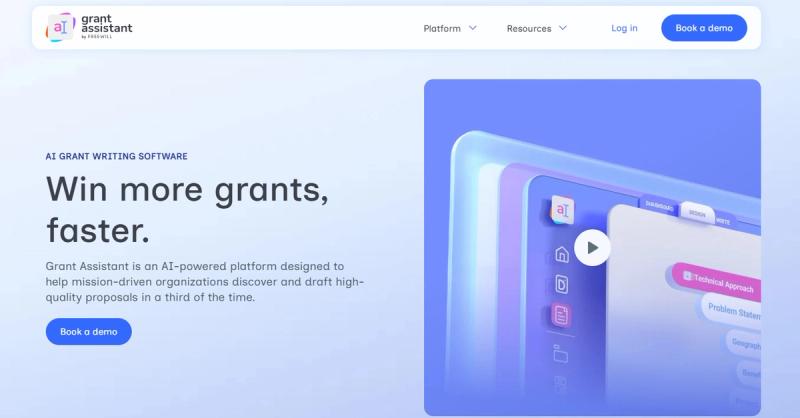
FreeWill is an established fundraising platform in the nonprofit space. Its AI-supported Grant Assistant is built by ex-USAID leaders and is trained on 7000+ successful grant proposals.
AI capabilities: The tool uses semantic AI to search and draft proposals that truly reflect your voice. It automates much of the initial drafting work and cuts proposal time by one-third of the usual hours. Organizations can analyze RFPs and use templates to write better grant applications.
Writing and research tasks supported
- Draft proposal with nonprofit-specific context
- Align proposals with federal or international funders
- Run a compliance review before submission
Key strengths for grant writing workflows:
The AI uses proprietary data to create funder-compliant proposals. It does not source from the web like ChatGPT but uses your ideas, research, and past proposals. Grant Assistant summarizes funding opportunities and drafts a proposal outline. It allows you to change writing style (concise, analytical, emotive, authoritative) and tone of voice. Furthermore, you can brainstorm with your team members and share ideas and notes within the platform.
Pricing: Contact for demo/pricing (enterprise-focused).
Limitations: Grant Assistant works best for organizations already in the FreeWill ecosystem. For others, a separate grant writing tool would make more sense.
Instrumentl
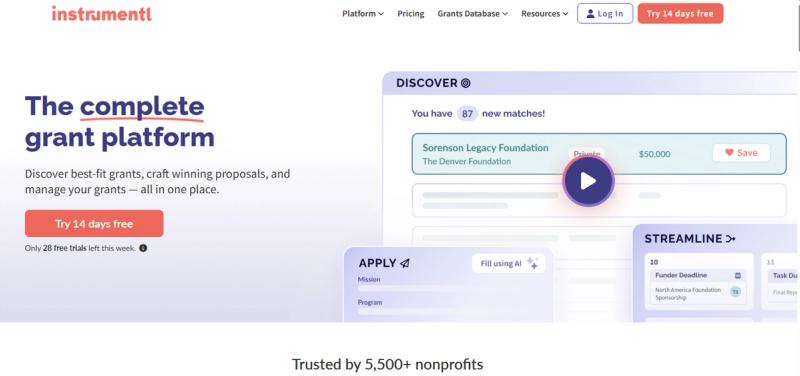
Instrumentl offers both AI writing tools and grant discovery. You can access and explore 20,000+ curated grants and search a database of 400,000+ active funders.
AI capabilities: It automates the entire process, including proposal drafting, deadline tracking, and portfolio overviews. The AI-powered peer prospecting helps you find funders already supporting similar organizations. The AI gives funding suggestions using data from Instrumentl 990 and funder insights. Moreover, you can use it to extract important details from grant agreements.
Writing and research tasks supported
- Discovering and filtering relevant opportunities from a massive database
- Monitor deadlines, tasks, and team responsibilities
- Drafting responses aligned with funder priorities
- Open and complete private grant forms within the platform
- Manage all post-award grant activities from a single dashboard
Key strengths for grant writing workflows:
It is a complete grant writing tool that covers all areas, from discovery to submission. The built-in AI tool (called Apply) helps with tracking grant opportunities and basic drafting. Moreover, you can monitor grant metrics and collaborate with the team.
Pricing: It has no free tier, and paid plans start at $299/mo (billed annually). Pro and advanced plans are available at $499/mo and $899/mo, respectively.
Limitations: The higher cost of Instrumentl makes it impractical for small organizations. Its AI writing features are not as evolved as dedicated drafting tools.
Wordtune
Wordtune is an AI writing assistant that helps you rewrite and improve existing text. You can polish draft sections of grant proposals to make them more persuasive. That said, Wordtune is not grant-specific, but useful for the editing phase of proposal writing.
AI capabilities: The AI helps you paraphrase, rewrite sentences, fix grammar, and more. Plus, it produces content that fits your style, voice, and subject matter. You can shorten and expand text, change tone (formal or casual), and use stronger vocabulary. Wordtune’s AI verifies a fact against at least five sources to improve accuracy.
Writing and research tasks supported
- Translate text from several languages (Hindi, Korean, French, Arabic, and more)
- Polish proposal sections to improve clarity and flow
- Adjust tone from formal to informal or vice versa
- Expand thin paragraphs by adding additional details
Key strengths for grant writing workflows: Wordtune’s browser extension works directly in grant portals and Google Docs. It provides natural-sounding alternatives to highly technical grants. The platform also excels at summarizing academic papers, YouTube videos, and articles. Furthermore, it also has a built-in AI Humanizer to humanize the core message.
Pricing: It has a basic free tier with 10 rewrites. Paid plans start at $6.99/mo and $9.99/mo (billed annually).
Limitations: Wordtune does not generate original content from a brief and grant guidelines. It is not the right tool to produce full proposal sections from scratch.
GrammarlyGo
Most writers already use Grammarly for grammar and spell-checking. Its AI tool GrammarlyGo allows you to generate text and adjust the “formality” of your proposal.
AI capabilities: GrammarlyGo generates new text, rewrites passages, and adjusts tone and style. You can change the formality (Casual, Neutral, Formal) and tone (personable, empathetic, witty, confident, engaging, direct) of the generated draft. Besides that, it offers contextual suggestions to polish final drafts before submission. Go also helps in maintaining a consistent tone and writing style throughout the proposal.
Writing and research tasks supported
- Real-time grammar, punctuation, and usage correction
- Sentence-level rewriting for clarity
- Context-aware suggestions based on your document’s purpose
- Deploys AI agents to provide relevant suggestions at the right time
- Works for web-based tools and tabs
Key strengths for grant writing workflows: Grammarly integrates into most working environments, including Google Docs, Microsoft Word, and browser-based tools. Grant writers do not have to change their workflow to benefit from it. Go fixes tone and errors at the editing and polishing stage. The built-in error-checking reduces the risk of submitting proposals with embarrassing mistakes and unclear language.
Pricing: Grammarly offers a free plan with basic grammar and spelling. GrammarlyGo features are available on the paid plans, starting at $12/mo.
Limitations: Unlike grant-specific tools, it does not understand funder priorities and grant structure.
Google NotebookLM
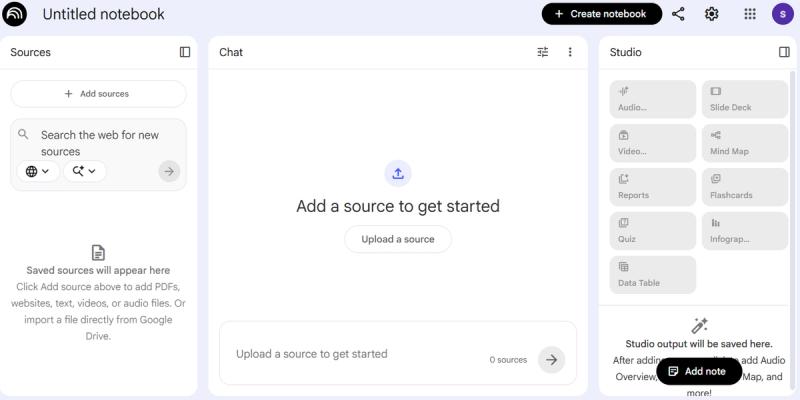
Google NotebookLM is the most underrated AI research assistant for grant writers. It summarizes uploads like studies and grant guidelines into helpful notes. This is perfect for drafting accurate proposals requiring heavy research.
AI capabilities: It uses Gemini’s latest models and accepts multimodal inputs. NotebookLM summarizes all sorts of sources, including websites, PDFs, YouTube videos, audio, slides, and more. It is more of a personalized AI expert that responds with information from your uploaded sources. The platform cites sources inline to quickly verify any claims.
Writing and research tasks supported
- Synthesizes multiple research documents into clear summaries
- Responds to specific queries using your uploaded sources
- Produces outlines and drafts content based on provided documents
- Create video/audio overviews, mind maps, quizzes, infographics, reports, flashcards from uploaded content
- Find relevant evidence from large datasets
Key strengths for grant writing workflows: NotebookLM is invaluable for research-heavy grant applications, like NIH, NSF, and academic program grants. It speeds up the process of synthesizing a large literature base for the background section. Unlike general AI, it does not hallucinate and responds with random internet data. Google NotebookLM anchors to your sources and is ideal for evidence-based writing.
Pricing: NotebookLM is available for free through Google. Pro and Premium plans are available with increased usage limits.
Limitations: It does not generate content without source documents. Plus, the platform lacks specific features like proposal tracking, funder discovery, and grammar checking. NotebookLM requires human drafting for final proposals.
Scite.ai
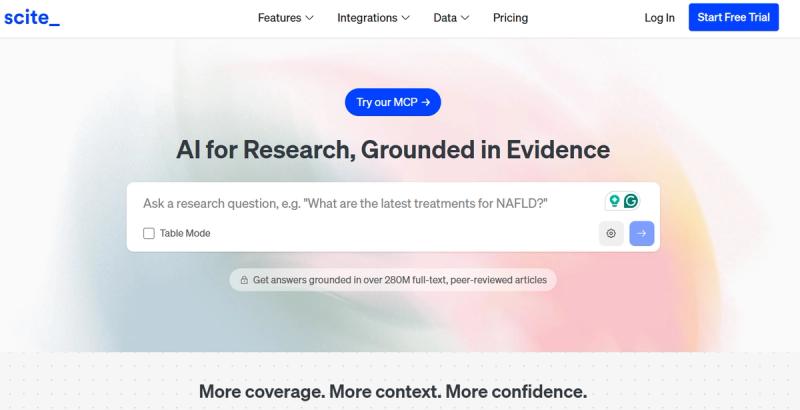
Scite is an important tool for anyone writing NIH, NSF, or research-focused grants. This citation analysis platform shows how scientific claims are cited, supported, and challenged in academic literature. It finds supporting evidence for your proposal and makes sure that cited papers are not retracted or disputed.
AI capabilities: Scite’s smart citation database analyzes and categorizes 1.6B citations from over 280M sources. It flags every reference in the paper as supported, mentioned, or contradicted. You can ask research questions and get answers from scientific literature with citation details. Scite AI also helps researchers find papers by title, author, keywords, or DOI.
Writing and research tasks supported
- Validate evidence claims in needs statements
- Verify that the research cited in the grant proposal is backed by subsequent studies
- Spot conflicting evidence early
- Find the most strongly supported recent research on a topic
Key strengths for grant writing workflows: Academic grant writers benefit greatly from checking the citation quality before submission. Grant reviewers at NIH and NSF quickly notice a proposal with outdated, disputed, and retracted research. Scite helps you build a stronger, more defensible argument supported by credible evidence.
Pricing: Scite offers a 7-day free trial and paid individual and institutional plans.
Limitations: It is not as useful for nonprofit and community grant writing. Its focus
Can AI Tools Actually Help With Grant Writing?
AI assistance is helpful for grant writing, but with important caveats. AI tools for grant writing in 2026 automate the time-consuming parts of the proposal drafting process. For example, summarizing research, generating first drafts, and aligning proposals with the funder's priorities. Teams using purpose-built platforms report completing proposals in significantly less time. AI can help an organization with limited staff capacity to submit more proposals annually.
That said, the human element is still the most important part. Without a doubt, AI excels at synthesizing data and drafting proposals. However, it can not “feel” the mission of your nonprofit or know the personal stories that make your work meaningful. It can not replace human oversight and final judgement required to craft high-impact proposals.
AI can make up facts, miss nuance, and generate misaligned proposals. Reviewers can quickly identify an AI-generated template that lacks specificity and voice. Therefore, AI is only helpful when used as a collaborator, not an author.
What About General Generative AI Tools Like ChatGPT?
General-purpose AI tools like ChatGPT, Gemini, and Claude can help with certain grant tasks. These include brainstorming, outlining, rephrasing passages, or light editing. They are free or cheap and handy in a pinch. Having said that, generative AI tools fall short for serious grant writing.
Unlike dedicated AI tools for grant proposal writing, they are not trained on grant-specific data or winning proposals. They do not inherently understand grant format, funder expectations, and compliance rules. More importantly, they process your prompts and uploads through public systems. This raises privacy concerns for sensitive proposals involving client data or proprietary research.
Besides that, general-purpose AI can also confidently generate false information. One study found GPT-4 hallucinates citations at rates around 28.6%. This could be a major problem when writing a research grant.
Specialized tools are generally a better choice for core drafting and strategy. They offer better security and use source-grounded responses to improve accuracy.
How to Choose the Right Grant Writing Tools for Your Needs
Here are some factors to consider when choosing the best tools for AI-driven grant writing:
- Grant Type: Scientific and academic grants require heavy research and citation verification. Grant writers can benefit the most from NotebookLM for researching source documents and Scite for citation analysis. GrantBoost, Grantable, and FreeWill’s Grant Assistant are perfect options for nonprofit grants. Okara is also a good starting point due to its multiple AI capabilities.
- Team Size: Solo grant writers and small teams can benefit from versatile, lower-cost tools like Wordtune, GrammarlyGo, and NotebookLM. In contrast, Instrumentl is ideal for large organizations managing multiple grants.
- Budget: Take advantage of free tiers and low-cost plans from Okara AI, NotebookLM, and GrantBoost. Expensive tools like Instrumentl are more practical when grant revenue can cover a $326/mo subscription.
- Experience Level: Some platforms have steep learning curves; therefore, they are not suitable for beginners. Grant Assistant, Okara, and Grantable are better suited for amateur grant writers. Tools like Scite.ai and Instrumentl work well for experienced writers.
Teams are advised to start with a unified, secure platform like Okara for research and drafting.
Best Practices for Using AI for Grant Writing
- AI is infamous for hallucinating citations and data, so always fact-check every output.
- Start with your own ideas and use AI to expand and refine your drafts.
- Ask AI to review and critique your drafts for clarity, tone, and gaps.
- Avoid sharing sensitive project details with public AI before reviewing its data handling policies.
- Edit AI proposal drafts to match your organization’s authentic voice and style.
- Conduct a full human review, or better yet, have a colleague read it before submission.
Privacy, Compliance, and Security Considerations
Data privacy in AI-assisted grant writing matters more than people realize. Commonly used AI tools like ChatGPT can expose ideas or proposal details. This is why grant writers should prioritize platforms with clear privacy policies and encryption.
The NIH 2025 policy (NOT-OD-25-132), effective September 25, 2025, covered the use of AI in grant applications. It prohibits proposals “substantially developed by AI” and limits PIs to six applications per year. Some funders now require you to disclose if AI was used in proposal preparation.
Always check each funder’s AI policy before submitting. Some foundations explicitly ban AI-generated content, and others require disclosure. When in doubt, use private platforms like Okara that guarantee data privacy and full control over AI outputs.
Need Useful AI Assistance for Your Proposals?
Okara.ai helps you streamline your grant writing without compromising quality and privacy. You can research, draft, refine, and review proposals without constantly switching between platforms. Try it free today and see if it fits your grant writing workflows.
Frequently Asked Questions
Is it safe to use AI when writing grant proposals?
Yes, private, encrypted platforms like Okara.ai are safe for writing grant proposals. Avoid sharing unpublished data with free, public AI tools before reviewing its privacy policy.
Is AI-generated/assisted grant writing allowed by funders?
Most funders allow AI assistance for editing, drafting, and brainstorming. Some (including NIH) prohibit substantial use of AI in grant applications. Always review each funder’s guidelines and disclose AI use when required.
What is the difference between a purpose-built grant writing tool and a general AI tool?
Purpose-built tools are trained on winning proposals and understand grant-specific requirements. They offer better security, templates, funder databases, and RFP analysis. Versatile general AI tools have high hallucination rates and lack specialization. Consequently, they require more prompting to produce grant-relevant outputs.
How accurate is AI-generated content for grant proposals?
AI can produce high-quality prompts, but it is never 100% accurate on its own. That said, the accuracy of the draft depends on prompts and uploaded data. A human reviewer should fact-check every AI-generated proposal section before submission.
Shouldn’t I just use ChatGPT for grant writing?
ChatGPT is not a specialized tool for grant writing, but can help with editing and brainstorming. Specialty tools offer better results and fewer security risks for high-stakes proposals.
How much time can AI save in the grant writing process?
Users commonly report saving 30% to 60% on routine sections. Grant writers can cut research synthesis time by 50% using tools like NotebookLM, Scite.ai, and Grant Assistant. It eliminates repetitive tasks; however, editing and human review still take time.
Get AI privacy without
compromise
Chat with Deepseek, Llama, Qwen, GLM, Mistral, and 30+ open-source models


Encrypted storage with client-side keys — conversations protected at rest
Shared context and memory across conversations
2 image generators (Stable Diffusion 3.5 Large & Qwen Image) included